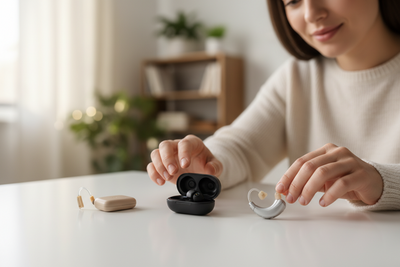
If you've shopped for hearing aids recently, you've probably noticed two very different power setups: tiny disposable batteries you replace by hand, or a charging case you dock overnight. Neither is "wrong," but they solve different problems.
Disposable (Zinc-Air) Batteries
For decades, this was the standard. These batteries activate when exposed to air, are widely available at pharmacies, and are simple to swap in an emergency. The tradeoff is upkeep: batteries need to be bought, stored, and changed regularly, and the small size can be genuinely difficult to handle for anyone with limited dexterity or vision.
Rechargeable (Lithium-Ion) Batteries
Most newer hearing aids, including modern OTC models, now build the battery into a sealed unit that you recharge in a case — the same basic idea as wireless earbuds. You dock them overnight and they're ready to wear the next day, with no loose batteries to buy, carry, or fumble with in a restaurant bathroom.
What to Watch for Either Way
Regardless of battery type, the National Institute on Deafness and Other Communication Disorders (NIDCD) recommends keeping hearing aids away from heat and moisture, turning them off when not in use, and — for disposable models — replacing dead batteries immediately and storing spares away from children and pets, since button batteries pose a swallowing hazard.
Which is right for you? If you travel frequently without easy access to charging, or you simply prefer the "swap and go" simplicity of disposables, that route still works. But if you'd rather never think about batteries again, rechargeable is the clear upgrade — and it's becoming the default for a reason.
Every Soundbright hearing aid — Mini, Discovery, Horizon One, and Horizon Pro — is fully rechargeable, with up to 48–60 hours of power per charge using the included case. See all models →