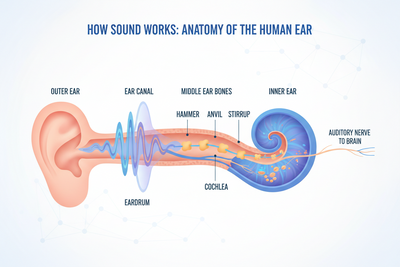
Close one eye and the world still looks mostly normal. Cover one ear, though, and something strange happens: you can still hear, but you lose track of where sounds are coming from. That's not a coincidence — it's the whole reason we have two ears instead of one.
How Your Brain Finds Sound
Your brain calculates the direction of a sound by comparing tiny differences between what each ear receives — a sound reaching your left ear a fraction of a millisecond before your right, or arriving slightly louder on one side. This binaural comparison is how you know a car is approaching from the left before you ever see it, or how you turn toward someone calling your name across a room.
Why Hearing Loss Disrupts This
When hearing loss affects the ears unevenly, the brain's timing-and-volume comparison breaks down, making it harder to localize sound accurately. That's part of why hearing health professionals generally recommend two hearing aids for people with hearing loss in both ears — it's not just about volume, it's about restoring the brain's ability to triangulate where sound is coming from.
A Surprising Research Detail
NIDCD-funded researchers have studied the ear structure of a tiny fly, Ormia ochracea, which has an unusually precise ability to locate sound despite its minuscule size. That research has directly informed the design of miniature directional microphones now used in hearing aids, which amplify sound from the direction you're facing while filtering out noise from other directions.
Why this is a safety issue, not just a convenience one: Sound localization is how we detect approaching traffic, sirens, someone shouting a warning, or a call from another room. Losing that ability isn't just isolating — it measurably changes how safely you can move through the world.
Soundbright's directional microphone technology is designed to help restore this sense of where sound is coming from, not just how loud it is. Compare models →