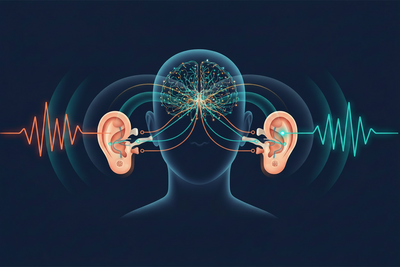
Your ears are doing something extraordinary right now — converting invisible pressure waves in the air into the electrical signals your brain experiences as sound. The process is extraordinarily precise, operates in real time, and depends on structures so delicate that a single loud noise can permanently alter them.
Understanding how your ears work also helps explain why hearing loss happens — and why it matters so much to protect what you have.
Step One: The Outer Ear
Sound begins as a vibration in the air. The outer ear — the visible part, called the pinna — acts as a funnel, collecting those vibrations and directing them down the ear canal to the eardrum. The shape of the pinna is not accidental: its folds amplify certain frequencies by 10–15 dB, particularly those in the 2,000–4,000 Hz range — the range most critical for understanding speech.
Step Two: The Middle Ear
Sound waves strike the eardrum, causing it to vibrate. Those vibrations travel through three of the smallest bones in the human body — the malleus, incus, and stapes (sometimes called the hammer, anvil, and stirrup). Together, these bones amplify the vibrations and transmit them from the air-filled middle ear into the fluid-filled inner ear.
This amplification is essential: without it, the energy of sound arriving at the eardrum would be almost entirely lost as it transferred from air to fluid.
Step Three: The Inner Ear
The vibrations enter the cochlea, a fluid-filled spiral structure roughly the size of a pea. Inside the cochlea are thousands of microscopic hair cells — specialized sensory cells that convert mechanical movement into electrical signals.
Different regions of the cochlea respond to different frequencies. High-pitched sounds (consonants, like the /s/ in "sun" or the /t/ in "top") activate hair cells at the base of the cochlea. Low-pitched sounds (vowels) activate cells deeper in the spiral. This is why age-related hearing loss typically affects high-frequency sounds first — the hair cells at the base are exposed to more mechanical stress and wear out sooner.
Critical fact: Hair cells in the human inner ear do not regenerate. Once damaged — by noise, aging, or other causes — that hearing capacity is permanently lost. This is why prevention and early treatment matter so much.
Step Four: The Brain
The electrical signals generated by the hair cells travel along the auditory nerve to the brain, where they are interpreted as sound. This is why researchers often say "we hear with our brains, not just our ears." The brain does enormous work — filling in gaps, filtering noise, identifying direction, and giving meaning to what we hear.
When hearing loss reduces the quality of the signal reaching the brain, the brain works harder to compensate — drawing on cognitive resources that would otherwise be available for memory, attention, and decision-making. This is part of why untreated hearing loss is associated with cognitive fatigue and, over time, cognitive decline.
What Hearing Aids Do
Modern hearing aids work by amplifying and processing sound before it reaches the ear — doing some of the work that damaged hair cells can no longer do. Advanced devices can selectively amplify speech frequencies, reduce background noise, and even adapt in real time to different listening environments. They don't restore the original hair cells, but they allow the auditory system and brain to receive a cleaner, richer signal.
Soundbright's FDA-registered hearing aids start at $99. Compare models →