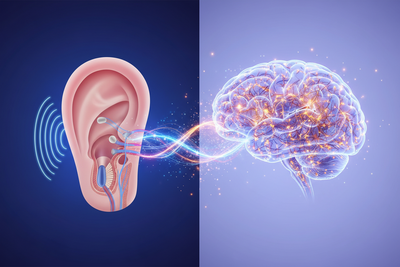
Most people think of hearing loss as a problem of the ears. But the ears are only the beginning. When sound fails to reach the brain clearly — for months, for years, for a decade — the consequences extend deep into how the brain itself is structured, connected, and able to function.
This is the story that audiology research has been uncovering for the past twenty years, and it changes the way hearing loss should be understood.
The Brain Works Harder — Then Wears Out
When hearing is impaired, the brain compensates. It recruits additional cognitive resources — attention, working memory, executive function — to decode the degraded signal coming from the ears. In the short term, this works. People adapt. Conversations still happen, life continues.
But over time, this constant extra cognitive load takes a toll. Researchers call it listening effort — and it's real, measurable, and cumulative. Studies have found that people with hearing loss show significantly greater brain activity than hearing peers when processing the same speech — not because they're doing more, but because they're struggling to do the same thing.
That effort comes at a cost. Resources spent on decoding sound are resources not available for memory, learning, planning, and the other cognitive functions that support quality of life.
Structural Changes in the Brain
Neuroimaging research has found that untreated hearing loss is associated with measurable structural changes in the brain. Studies using MRI have documented accelerated atrophy — shrinkage — in the auditory cortex and surrounding temporal regions in people with long-term hearing loss compared to those with normal hearing.
The temporal lobe — critical for language processing and memory — shows less atrophy in hearing aid users than in non-users with similar hearing loss. This suggests that restoring a clear auditory signal may help preserve the brain structures that depend on it.
2024 Lancet Commission: Hearing loss is the single largest modifiable risk factor for dementia from mid-life. A 2024 meta-analysis of 50 studies found that each 10-decibel worsening of hearing is associated with a 16% increase in dementia risk.
Social Deprivation and Its Cognitive Consequences
The cognitive effects of hearing loss are not only direct — they're also mediated through social withdrawal. When conversations become exhausting and social situations feel overwhelming, people with hearing loss gradually disengage. They attend fewer gatherings, participate less actively in conversations, and spend more time in unstimulating, isolated environments.
This matters because social and cognitive engagement are among the most powerful protections against cognitive aging. The brain, like any complex system, thrives on use. Social withdrawal — even if chosen as a coping mechanism — accelerates exactly the cognitive decline that untreated hearing loss already risks.
The Other Side: What Treating Hearing Loss Does for the Brain
The research on this is now among the most important in public health. The landmark ACHIEVE trial (Johns Hopkins, 2023) found that among older adults at higher risk for cognitive decline, using hearing aids for three years slowed cognitive decline by 48%.
MRI studies show that hearing aid users maintain greater gray matter volume in auditory and cognitive processing areas. Brain scans show reduced cognitive effort when processing speech in hearing aid users compared to non-users. Earlier intervention appears to offer greater protection.
Hearing aids are only about hearing better. They may be one of the most effective tools available for protecting long-term brain health — which makes the decision to address hearing loss not just an auditory choice, but a neurological one.
The brain you protect today is the one you'll rely on for decades to come. The earlier you act, the more of it you keep.
Soundbright offers FDA-registered hearing aids from $99 with a 45-day risk-free trial, backed by hear.com and lifetime support. Start here →