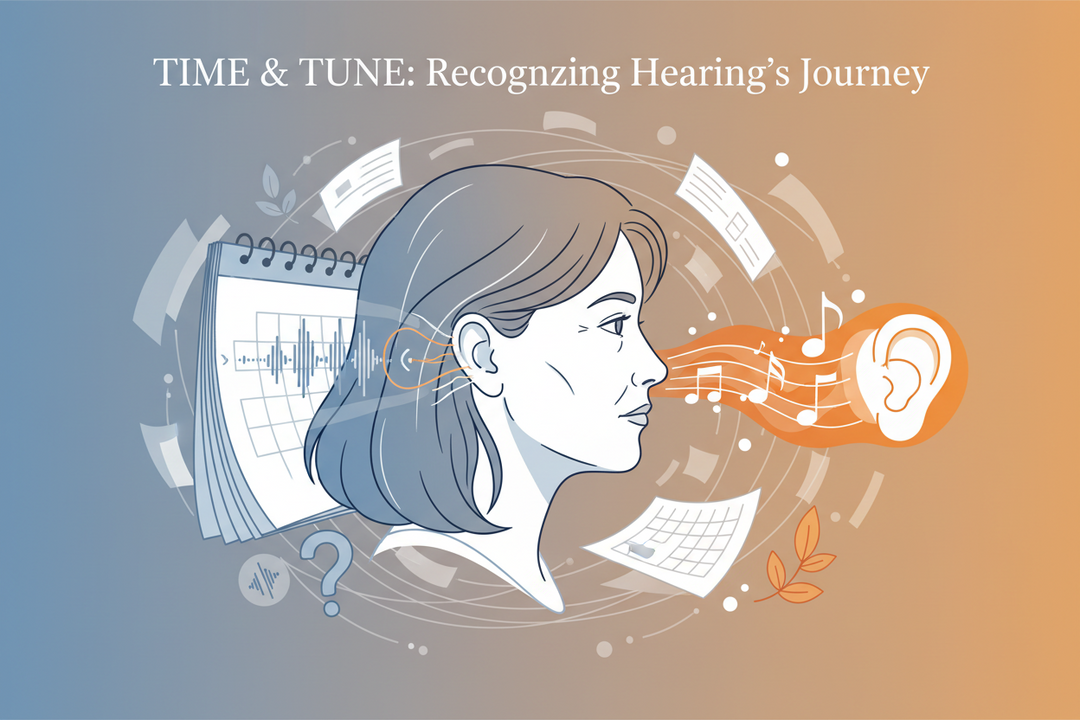
The average person waits seven to ten years between first noticing hearing difficulties and taking action. That's a decade of unnecessary strain — on relationships, on cognitive health, on professional life, and on overall quality of living. And yet the delay is remarkably common and remarkably predictable.
Understanding why the wait happens is the first step toward shortening it.
The Slow Onset Problem
Hearing loss rarely announces itself dramatically. It arrives gradually — so gradually that the person experiencing it often doesn't notice until the change is already significant. The brain is extraordinarily adaptive: it fills in gaps, relies more heavily on context, and unconsciously increases cognitive effort to compensate. What feels like "fine" hearing is often, by this point, considerably degraded.
Family members and close friends almost always notice the change before the person with hearing loss does. This is one reason why so many of these conversations are initiated by someone else — a partner, an adult child, a doctor.
Stigma and Identity
For many people, hearing loss is bound up with aging — and admitting to hearing difficulties can feel like admitting to getting old. Research confirms that this stigma is a real and significant barrier, particularly among men and among people in high-performance or leadership roles who are accustomed to projecting capability.
The mental calculus often goes: if I acknowledge the problem, I have to confront what it means. So the acknowledgment is deferred, repeatedly, until the problem becomes impossible to ignore.
Misconceptions About Hearing Aids
Many people delay because their mental image of hearing aids is decades out of date — large, whistling devices that announce hearing loss loudly and work poorly. Today's hearing aids are small enough to be nearly invisible, rechargeable, connected to smartphones via Bluetooth, and sophisticated enough to distinguish between speech and background noise in real time.
The technology gap between what people imagine and what's actually available is one of the most consistent surprises for first-time hearing aid users. Hearing aids are bulky and obvious. Many current models sit entirely within the ear canal and are undetectable to others.
The Cost Barrier
Traditional prescription hearing aids can cost $3,000–$6,000 per pair — a genuine barrier for many households. The availability of FDA-registered over-the-counter hearing aids, however, has shifted this landscape significantly. High-quality, effective devices now start at under $100, removing cost as an unavoidable obstacle for most people.
The real cost of waiting: Untreated hearing loss is associated with higher rates of depression, social isolation, cognitive decline, and healthcare utilization. The cost of inaction — measured in quality of life and health outcomes — typically far exceeds the cost of treatment.
The One Step That Changes Everything
A hearing test. It costs nothing to know where your hearing stands. It's painless, takes less than an hour, and produces concrete information you can act on — or choose not to act on. But at least you know.
If you've been waiting, there's no better time to stop.
Soundbright offers FDA-registered hearing aids from $99 with a 45-day risk-free trial and lifetime support. Start here →