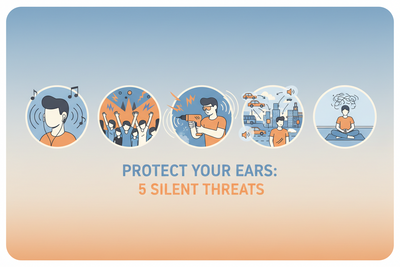
Most hearing damage doesn't happen at a rock concert. It happens quietly — at the gym, on a commute, in a loud restaurant — day after day, without any warning signal. By the time you notice something is wrong, the damage is already done.
Understanding sound levels is one of the simplest and most overlooked steps you can take to protect your hearing for life.
How Sound Is Measured
Sound intensity is measured in decibels (dB). The scale is logarithmic — meaning a sound at 90 dB isn't just a little louder than 80 dB, it's 10 times more intense. A jump from 85 to 88 dB cuts your safe exposure time in half.
According to the National Institute on Deafness and Other Communication Disorders (NIDCD), sounds at or below 70 dB are generally safe for unlimited exposure. The danger zone begins at 85 dB, where repeated or prolonged exposure starts permanently damaging the tiny hair cells inside your inner ear — and those cells do not regenerate once lost.
Everyday Sounds and Where They Fall
- Normal conversation — ~60 dB. Safe indefinitely. This is the baseline for comfortable human speech.
- City traffic inside a car — ~80–85 dB. Borderline. Long daily commutes with windows down can add up over months and years.
- A lawnmower or motorcycle — ~90 dB. At this level, OSHA guidelines recommend no more than 2 hours of unprotected exposure per day.
- A live concert or sporting event — ~100–110 dB. Damage can occur in as little as 5 minutes at sustained 100 dB levels.
- Earbuds or headphones at maximum volume — up to 110 dB. One of the most common (and underestimated) sources of noise-induced hearing loss, particularly among younger people.
- Fireworks or gunfire — ~140–165 dB. A single exposure at these levels can cause immediate permanent hearing loss.
Quick test: If you need to raise your voice to be heard by someone standing an arm's length away, the noise around you is likely above 85 dB — the threshold for hearing damage.
The Rule of Halves
Here's a fact that surprises most people: for every 3 dB increase in sound above 85 dB, the safe listening time is cut in half. At 85 dB you have 8 hours. At 88 dB, 4 hours. At 91 dB, 2 hours. At 100 dB, less than 15 minutes.
This is why a brief exposure to very loud sound — like being near fireworks or a gunshot — can cause more damage than an entire workday in a moderately noisy environment.
Practical Steps That Actually Help
Turn it down by just 3 dB. According to the Hearing Health Foundation, reducing volume by 3 dB cuts the risk of hearing damage in half. It's one of the highest-return hearing protection habits you can develop.
Carry earplugs. Think of them the way you'd think of sunscreen — protective gear for an invisible, cumulative risk. Earplugs can reduce noise by 15–30 dB and are available at any pharmacy.
Take quiet breaks. After exposure to loud environments, giving your ears time to recover reduces the cumulative toll. The sensory cells in your inner ear fatigue under noise — rest helps them recover before permanent damage sets in.
And if you're already noticing ringing in your ears after loud events, or sounds that seem muffled — those are early warning signs worth taking seriously.
Soundbright offers FDA-registered hearing aids starting at $99. Start here →