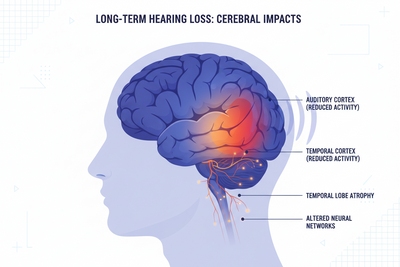
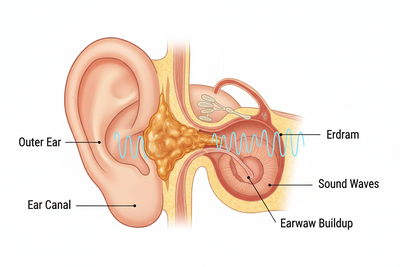
Most people think of hearing loss as an inconvenience — something that makes TV harder to follow or conversations more tiring. What they don't realize is that the effects stretch far beyond the ears. A growing body of research is showing a measurable connection between hearing health and the long-term health of the brain.
What the Research Actually Says
The 2024 Lancet Commission on Dementia Prevention identified hearing loss as the single largest modifiable risk factor for dementia from mid-life — ranking it above factors like smoking, physical inactivity, and depression. A major meta-analysis of 50 studies involving over 1.5 million participants, published in 2024, found that adult-onset hearing loss significantly increases the risk of cognitive decline, mild cognitive impairment, and Alzheimer's disease.
The numbers are striking: each 10-decibel worsening of hearing is associated with a 16% increase in dementia risk. Overall, people with untreated hearing loss have a 35% higher risk of developing dementia compared to those with normal hearing.
Key finding: The 2024 Lancet Commission estimated that treating hearing loss could prevent up to 7% of all dementia cases globally — making it one of the most impactful areas for prevention.
Why Does Hearing Loss Affect the Brain?
Researchers have proposed several pathways. One is cognitive load: when hearing is impaired, the brain must work significantly harder just to process speech. That extra effort draws resources away from memory, attention, and other cognitive functions. Think of it as constantly running a demanding background program that slows everything else down.
A second pathway involves social isolation. People with untreated hearing loss tend to withdraw from conversations and social situations — and social engagement is one of the most important factors in maintaining brain health as we age.
A third hypothesis involves auditory deprivation: when the brain stops receiving rich sound input over time, areas responsible for processing language can begin to shrink or rewire in ways that accelerate cognitive aging.
The ACHIEVE Study: A Landmark Finding
In 2023, researchers published results from the ACHIEVE trial — the largest randomized controlled study of its kind — following 977 adults aged 70–84 with untreated hearing loss for three years. Among participants who were already at higher risk of cognitive decline, using hearing aids slowed cognitive decline by 48% over the study period.
As the lead researcher, Dr. Frank Lin of Johns Hopkins, noted: treating hearing loss is something concrete, accessible, and effective — unlike many dementia risk factors, which remain difficult or impossible to address.
What This Means for You
The good news is that hearing loss is treatable. And the earlier it's addressed, the better the outcomes appear to be. A 25-year French follow-up study found that early adoption of hearing aids — within three years of diagnosis — provided significantly better cognitive protection than delayed treatment.
Hearing loss is just part of getting older — there's nothing to do about it. Today, affordable and effective solutions exist. Treating your hearing isn't just about hearing better. It may be one of the most meaningful things you can do for your long-term brain health.
Think your hearing may have changed? Getting a hearing test is fast, painless, and gives you clear information to act on. Explore Soundbright hearing aids →