It starts innocently enough. You bump the volume up a few notches to catch the dialogue. A few months later, it's a few more. Eventually someone else sits down in the room and flinches. "It's so loud in here." You had no idea.
The gradual TV volume creep is one of the most common — and commonly dismissed — signs of age-related hearing change. And it's worth taking seriously.
Why TV Is Harder to Hear Than Real Life
In face-to-face conversation, your brain uses every available tool: lip reading, facial expressions, body language, context, and direct eye contact. On television, especially dialogue-heavy programming, you have only audio — and that audio is often compressed, mixed with sound effects and music, and delivered without any of the visual cues your brain typically relies on to fill in the gaps.
This means that TV is often the first place people notice hearing changes — before they notice any difficulty in everyday conversation. The loss of consonant sounds (which carry most of the meaning in speech) makes dialogue sound muffled or unclear even when the overall volume seems adequate.
What the Research Says
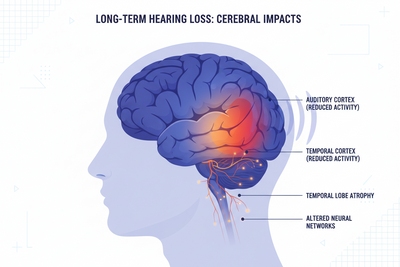
According to the University of Kansas Health System, one of the most characteristic features of sensorineural hearing loss — the most common type — is that speech sounds muffled or like everyone is mumbling. This isn't a problem with volume. It's a problem with clarity at the frequency level. Vowels remain audible; consonants — the /t/, /f/, /s/, /k/ sounds that distinguish words — become increasingly hard to detect.
Turning the TV up louder doesn't solve this. It makes everything louder — including the background sounds — but doesn't restore the high-frequency clarity that's been lost.
Common pattern: Turning the TV up is often noticed first by family members or partners — not by the person with the hearing change. This is because the change is gradual and the brain adapts, filling in gaps without the person being aware it's happening.
Other Signs That Often Appear Alongside
- Preferring subtitles not for a second language, but for content in your own language.
- Struggling with phone calls more than in-person conversations.
- Mishearing words in a specific predictable pattern — confusing similar-sounding words, especially those that differ only in their consonants.
- Needing to concentrate harder than usual just to follow along with what you're watching.
What to Do About It
The first step is a hearing test. It's not a commitment to do anything — it's simply information. A hearing assessment tells you exactly where your hearing stands across all frequencies, and whether what you're noticing matches a pattern that could benefit from treatment.
Modern hearing aids don't just make things louder. They restore clarity — amplifying the specific frequencies that have weakened while preserving the ones that haven't. Many people who try hearing aids for the first time are surprised to find they can watch TV at a volume that no longer bothers the rest of the room.
Soundbright hearing aids start at $99, with a 45-day risk-free trial. Start here →